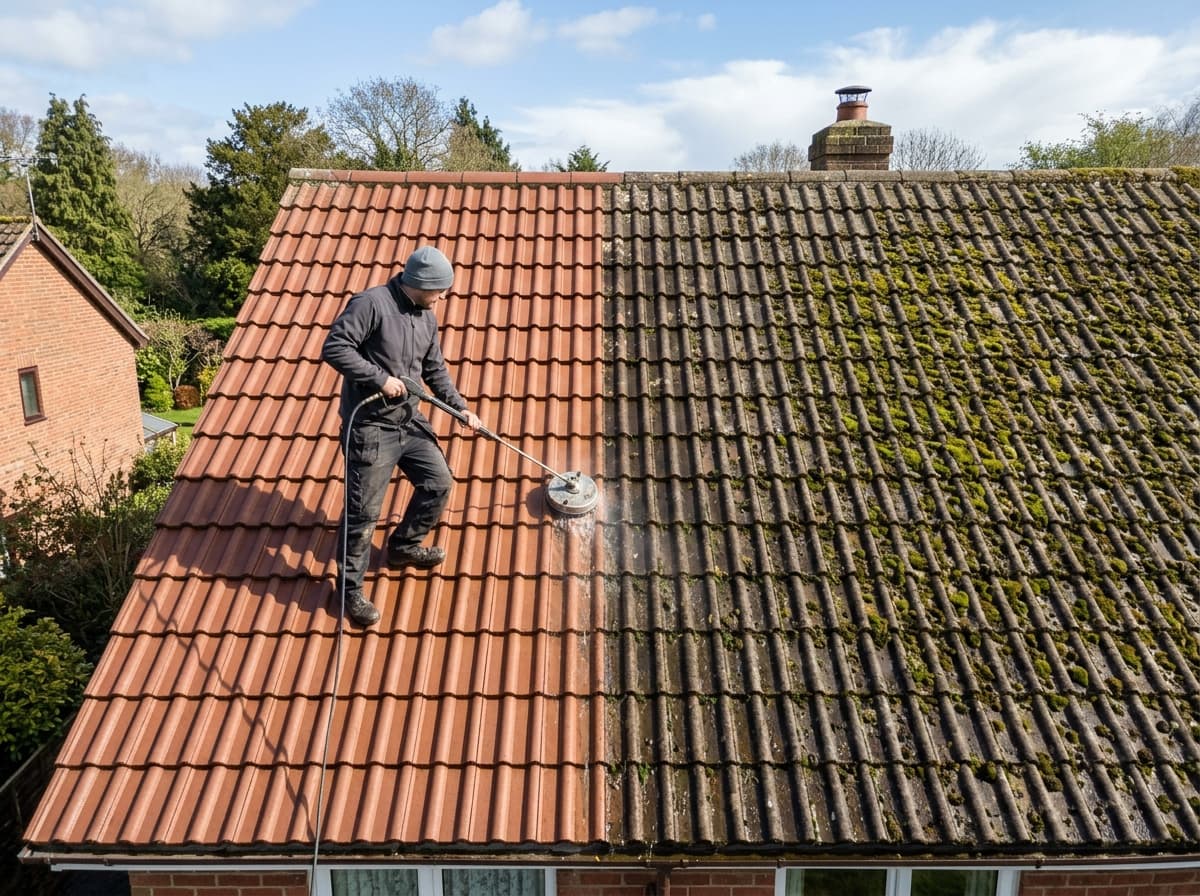
Roof Cleaning in West Sussex
Removing moss and organic growth that traps moisture against tiles and can lift them over time.
Roof Cleaning in West Sussex
West Sussex is varied enough that "roof cleaning" means something genuinely different depending on where you are in the county. Along the coast and around Chichester Harbour — Bognor Regis, Felpham, Selsey, Bosham and the harbour villages between them — salt-laden wind-driven rain keeps roofs damp for longer between dry spells, and that dampness is exactly what moss, algae and black lichen streaking need to establish and spread. Move inland to the wooded Weald villages around Billingshurst, Wisborough Green and Rudgwick, and the picture changes again: it isn't salt air doing the damage, it's tree cover. Roofs under or near mature oak, beech and pine canopy collect organic debris in their valleys and gutters more or less constantly, and that debris holds moisture against the tiles whether the roof faces north or south.
Head into the South Downs and the cluster of historic market towns and villages around Midhurst, Petworth, Singleton and Amberley, and a different factor comes into play: conservation area status and, in many cases, South Downs National Park designation. Cleaning moss and algae off a natural slate, clay peg tile or even a thatched roof on a listed or conservation-area property calls for the same careful, non-abrasive approach everywhere else, but the margin for error is smaller — aggressive pressure-washing that strips a protective surface or dislodges an old fixing is a bigger problem on a period roof than a modern estate one.
The Arun and Adur valleys — Arundel, Littlehampton, Worthing, Lancing, Shoreham-by-Sea, Steyning — combine coastal salt exposure with river-valley humidity, while the northern Weald around Crawley and Horsham, and the Mid Sussex towns around Haywards Heath and Burgess Hill, are generally more sheltered but see their own mix of newer estate housing and older, tree-shaded properties. In every case, the method stays the same: careful manual clearance rather than harsh pressure-washing, which risks stripping the protective granule coating off some tile types or forcing water in under the covering, with gutters and valleys cleared at the same time since that's usually where the trapped debris that started the problem is sitting.
The town pages below apply that same careful approach with the specific local detail that matters for each place — whether that's coastal or harbourside salt exposure, overhanging tree cover, a conservation designation, or simply a younger, more uniform roofing stock that behaves differently to an older market town's. Find your town to see what applies where you are.
Benefits of Our Roof Cleaning & Moss Removal Service
- ✓Manual removal rather than harsh pressure-washing, which can strip protective coatings or force water under tiles
- ✓Gutters and valleys cleared at the same time — usually where the trapped debris is coming from
- ✓Catches lifted or dislodged tiles caused by moss growth before they become a leak
Roof Cleaning — Areas We Cover
Coastal Plain & Chichester Harbour
The Channel coast and Chichester Harbour bring salt-laden wind-driven rain to this stretch of West Sussex, keeping roofs damp for longer between dry spells — the exact conditions moss and algae need to establish.
South Downs & Western Weald
A cluster of historic market towns and villages on the South Downs National Park and the western Weald, many with conservation-area cores where natural slate, clay peg tile or thatch is the expected covering.
Arun & Adur Valleys and Coast
From Arundel and Littlehampton along the Arun to Worthing, Lancing and Shoreham-by-Sea on the Adur, this stretch combines coastal salt exposure with genuine river-valley humidity.
Northern Weald — Crawley & Horsham District
From Crawley's new-town estates to the wooded villages around Horsham, this part of the county sees no coastal exposure — organic debris from heavy Wealden tree cover is the more common issue here.
Mid Sussex
Burgess Hill, Haywards Heath and the surrounding villages sit on the Mid Sussex ridge, catching a reasonable share of South Downs weather with a genuine mix of Victorian, Edwardian and modern estate roofing.
Roof Cleaning in West Sussex — Frequently Asked Questions
The method stays consistent — careful manual clearance rather than harsh pressure-washing, with gutters and valleys cleared at the same time — but what's driving the moss or algae growth genuinely varies. Coastal and harbourside towns deal with salt-laden damp air keeping roofs wet for longer; Weald villages deal with organic debris from overhanging trees; and South Downs conservation-area towns need extra care around older slate, clay tile and thatch so cleaning doesn't damage a protected roof covering.
The cleaning approach itself — manual removal rather than pressure-washing — is the same everywhere, because it's the gentlest method regardless of designation. Where a conservation area or National Park designation matters more is in any follow-on repair: natural slate, clay tile or thatch is typically expected on these properties over a modern concrete alternative, so any tiles disturbed or found damaged during cleaning need replacing in kind.
It usually comes down to how quickly the roof dries out between wet spells. A shaded, north-facing roof, one under overhanging trees, or one that's regularly damp from coastal or harbourside wind-driven rain will all hold moisture for longer than an exposed, quick-drying roof — and that damp is exactly what lets moss and algae re-establish.
Yes — wherever a local roofer is cleaning a roof, they'll clear the gutters and valleys at the same time, since that's usually where the organic debris and moss that caused the problem in the first place has been collecting.
It's more than cosmetic — moss holds moisture against the roof covering for much longer than a clean, exposed tile would experience, and as it thickens it can lift tiles at their edges. Left long enough, it becomes a genuine leak risk rather than just an appearance issue.
Shaded or north-facing roof slopes, and roofs under or near overhanging trees — common across the wooded Weald and many South Downs villages — stay damp for longer and collect more organic debris, both of which give moss and algae the conditions they need to establish.
It can — pressure-washing risks stripping the protective granule coating off some tile types and forcing water in under the covering. A local roofer will generally recommend careful manual removal instead, and can advise on what's right for your specific roof.
Ready to Start Your Roof Cleaning in West Sussex?
Book your free no-obligation survey today.